
Useful in an ordinary room
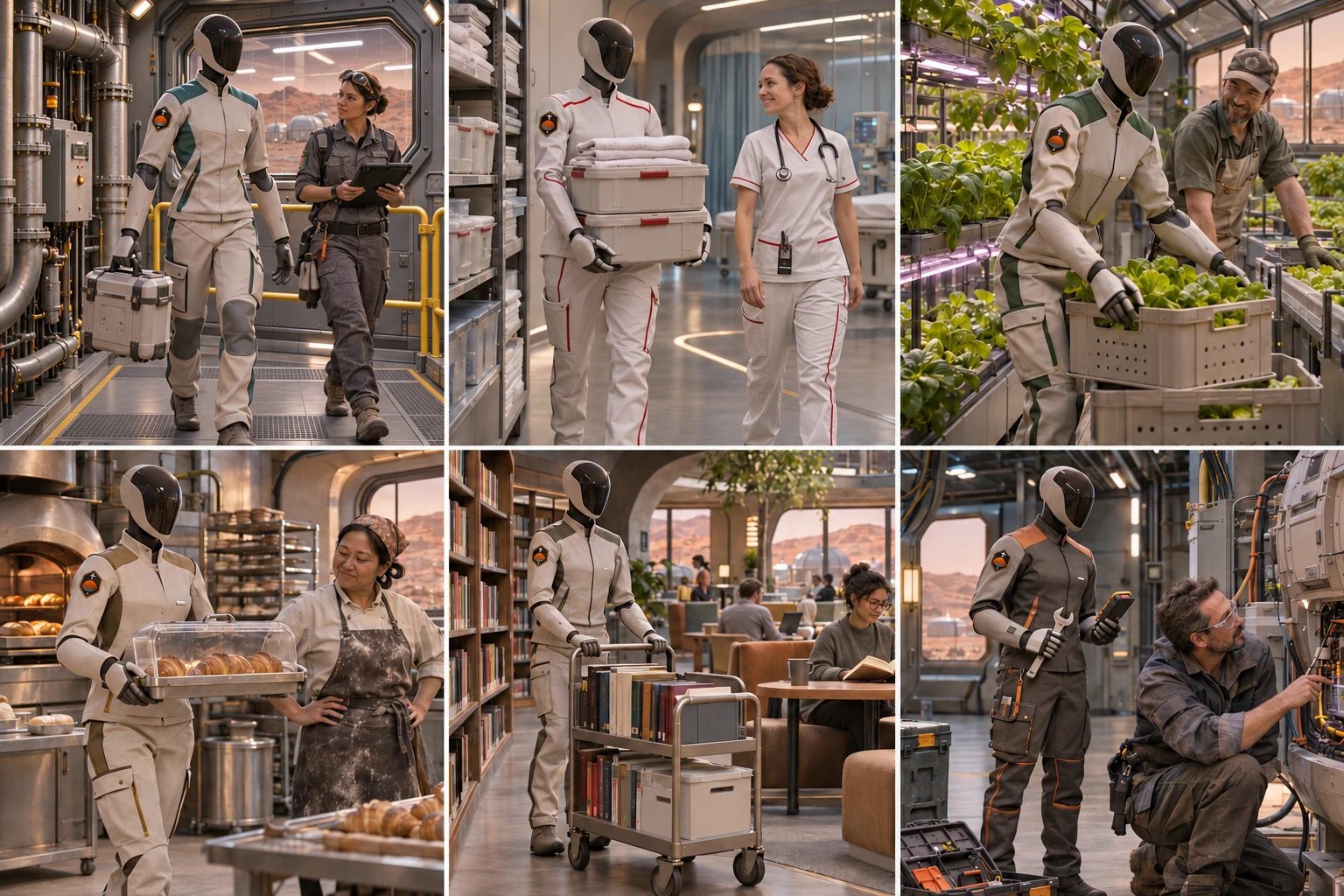
A humanoid can work beside a person in a room built around human reach, tools and routes. Concord’s indoor service family brings that familiar form to different tasks: carrying a closed sample carrier, delivering clean supplies, moving a harvest crate, handling a bakery tray or returning books to a cart.
Department colors connect the machines with their work. Teal belongs to Utilities, copper to Engineering, dark green to Agriculture and white with restrained red to Medical support. The shared form gives the family a recognizable identity while each assignment still needs its own tools, safe route and responsible people.
People keep the consequential decisions
A medical-support machine brings supplies to a clinician. A bakery assistant carries a tray while a baker judges the food. A growing machine helps move a harvest while a grower watches the crop. A useful pair of hands belongs inside a larger process of training, checks and judgment.
The ordinary service family is unarmed. Its value comes from being available for repeatable work in protected interiors. Heavy cutting, grading, exterior hauling and remote inspection continue to use bodies chosen for those environments.
How repetition becomes abundance
Automation lowers the labor needed for repeatable tasks and can reduce spoilage, waste and avoidable downtime. Those gains help make meals, essentials and useful services cheaper, while leaving people more time for family, learning and work that needs judgment.
Energy, feedstock, tools, charging, replacement parts and maintenance remain real costs. Keeping useful machines in service matters as much as adding more of them. How the town shares productive ownership and pays its obligations remains a separate human decision.